
Gartner Data Integration Survey
October 2012 – All the normal suspects. However, was surprised (and pleased) to see Talend in the mix. Interesting to note that SAS is in the lead with the number of installs (13k) – up there with Microsoft (12k).
Gartner Data Integration Survey
October 2012 – All the normal suspects. However, was surprised (and pleased) to see Talend in the mix. Interesting to note that SAS is in the lead with the number of installs (13k) – up there with Microsoft (12k).
Given what just put out about TIBCO, thought that I should put this out as they show up here under MDM as well.
18 October 2012 ID:G00233198
Analyst(s): John Radcliffe, Bill O’Kane
Organizations selecting a solution for master data management of customer data still face challenges. Overall, functionality continues to mature, but some of the well-established vendors’ messages are getting more complex. Meanwhile, less-established vendors continue to build up their credentials.
Another reason why Data Management and Analysts cannot lead separate lives
I found this article interesting in that it points out why the bridge between the data side of the house and the analytical side must be well established – if the data team implements a design that does not support analytics, it has material impacts. I know this is blindingly obvious, but ….
I have recently been in a number of discussions where the attitude was we are going to build the data warehouse using best practices and years of experience, and it really does not matter what you are going to do with the data. I know it crazy, but… you know what I am talking about – we see it all the time.
The article itself tests performance on a columnar versus relational approach to persisting data, and has some surprising results – 4,100% improvement! I would be interested in other studies that have looked at the difference between different data architectures when performing analytical tasks.
Hadoop and Big Data – it is about what you do with the data!!
Some good videos from TechTarget and Wayne Eckerson – for a data guy he talks a lot about analytics.
This blog was started to write about analytics – so here I go again on ETL! Seems that if you are working on Big Data things, it always starts with the data, and in many respects that is the thing that is most difficult – or perhaps requires the most wrenching changes – See this Creating an Enterprise Data Strategy for some interesting facts on data strategies.
ETL is a chore at the best of times. Analysts are generally in a rush to get data into a format that supports the analytical task of the day. Often this means taking the data from the data source and performing the data integration required to make the data analytically ready. This is often done at the expense of any effort by the data management folks to apply controls oriented at data quality issues.
This has created a tension between the data management side of the house and the analytical group. The data management folks are focused on getting data into an enterprise Warehouse or DataMart in a consistent format with data defined and structured in accordance with definitions and linkages defined through the data governance process. Analysts on the other hand – especially those engaged in adaptive type of analytical challenges – seem always to be looking at data through a different lens. Analysts often want to apply different entity resolution rules; want to understand new linkages (implies new schema); and, generally seek to apply a much looser structure to the data in order to expose insights that are often hidden by the enterprise ETL process.
This mismatch in requirements can be addressed in many ways. However, a key starting step is to redefine the meaning of ETL within an organization. I like the definition attributed to Michael Porter where he defines a “Lifecycle of Transformation” that shows how data is managed from the raw or source state through to application in a business context (Larger Image)

Value Chain of Transformation
I am pretty sure that Michael Porter does not think of himself as an ETL person, and the article (Page 14) I obtained this from indicates that this perspective is not ETL. However, I submit that the perspective that ETL stops once you have data in the Warehouse or the DataMart is just too limiting, and creates a false divide. Data must be both useable and actionable – not just useable. By looking at the ETL challenge across the entire transformation (does that make ETL TL TL TL …?), practitioners are more likely to meet the needs of business users.
Related discussions for future entries:
The overall challenge is one of sorting out the metadata management within the organization. Presumably this is creating data quality problems of some sort.
It is somewhat hard to evaluate the metadata question in the absence of a few other data points, as metadata is everywhere, and is influenced by numerous factors: overall data management policies, the information architecture, the system architecture, and the security policies to name a few. Additionally, there is often a mis-alignment between these factors and how the organization’s management structure supports data management best practices.
First step – define the data quality issue. This breaks out along three dimensions: 1. how users find and retrieve data assets; 2. How data is delivered; and, 3. how data is managed.
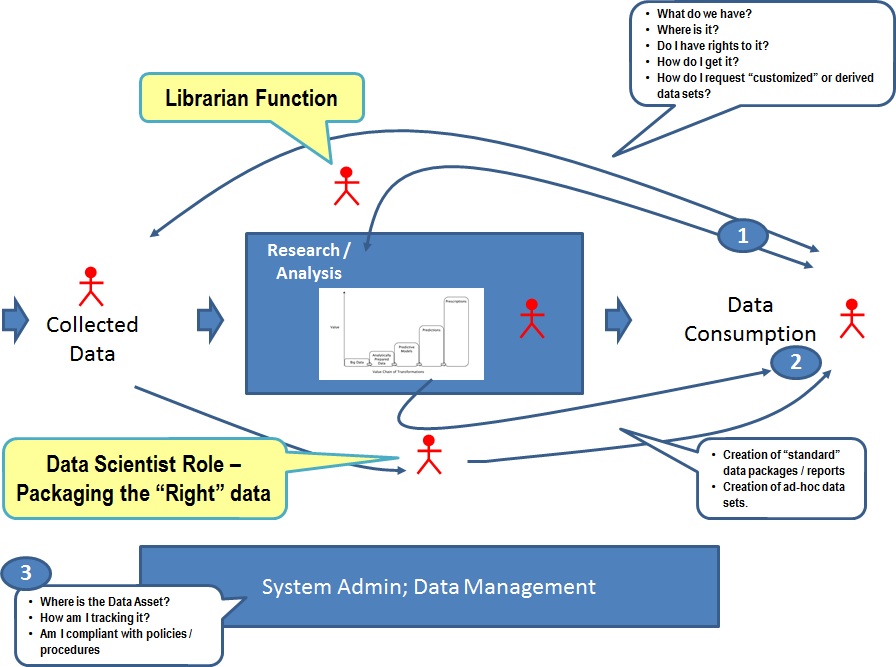
Breaking data down along these dimensions will expose the function that is creating the duplication and the kind of metadata involved.
Additionally viewing the problem this way will address how the organization is thinking about the process. How is the library function addressed? Is there a cataloging function that keeps an inventory of all data assets available to the organization? Is there a role of data scientist – perhaps data “packager” is a better term for most organizations. Is there an organizational element to why metadata is getting fragmented? An example of this would be that the Librarian function is organizationally part of the Research Division. Data collection and packaging is an IT function. The Library software that manages the search and cataloging functions is managed separately from the metadata management system supporting the data warehouse. Anything done by Research creates fragmentation, and possibly duplication of metadata.
Once this perspective is applied, one gets a better idea of the impact related to the data quality problem. Issues of a cumbersome search interface, can be addressed in the short term through better training, or increased resources on the help desk. However, security or audit related shortcomings might result in a security breach which would have much greater impact.
So what to do? Clearly this is not just a metadata problem. In many organizations, the challenge of duplicated metadata is created by legacy environments that have grown fragmented over time. The roadmap that defines the path forward will be unique for each organization. However, a few best practices are called for.
From a platform perspective there are two best practice considerations: a metadata registry should be evaluated; and metamodels created by which all metadata are viewed. The registry is most important, as it imposes a discipline on the metadata management process.
Think of a metadata registry as the “reference data” or the “controlled vocabulary” for metadata. For any given data asset, it defines what metadata one should expect to see. If it is not in the metadata registry, it should not exist. All of the IT tools that are engaged in moving, enhancing or creating derived works from data assets should use the metadata registry as the reference source for all activity related to metadata. This reduces the likelihood that metadata will need to be duplicated, and if it is duplicated, it reduces the likelihood that it is duplicated incorrectly.
This is managed by the ISO 11179 specification. My sense is that the development of a metadata registry is something that comes with Big Data. Just like reference data, and master data, metadata is a management challenge that is supported by IT capabilities NOT the other way around.

 analyticaltern